
Social Order, Shared Space, and Little Norms
I often wonder about the ideal or most appropriate level of social order — and how it becomes social code or common etiquette.
Do we wear our shoes inside, or not? Do we squat, or do we sit? Do we stand on one side of the escalator so others can pass, or are we only concerned with the step beneath our own feet?
A new climbing gym opened near my house. It’s beautiful, and quite literally sparkling. I find myself not wanting to wear my outside shoes in, but also not wanting to walk around barefoot if everyone else is wearing theirs — especially as winter approaches. There’s also no “no-shoes” signage in areas where shoes truly shouldn’t be (like the locker room with showers), which makes it difficult to be truly relaxed in these spaces.
I think without a shared social code, we default to protecting ourselves from the worst behavior, and prepare for the worst possible outcomes. And that subtle vibration of mistrust becomes part of daily life.
A Swedish Perspective
I don’t recall thinking much about this before living in Stockholm, but I find myself constantly missing the Swedish social order. At my climbing gym there, you took your shoes off before you even checked in. No mud, sleet, or street grit tracked through the space — so if you were walking barefoot, you weren’t walking on the city street. On escalators, people stood to the right so others could pass. And there was a shared understanding that people sat on the toilet seat — so you could too. I found the predictability that came with a higher level or social order increased trust, and made life easier and more enjoyable for me.
I suppose this is the difference between communal and individualistic cultures. But I also wonder how deeply rooted these identities are. And how do social codes first take shape? Could a single climbing gym catalyze a cultural shift by adopting a more structured approach to something as simple as shoes?
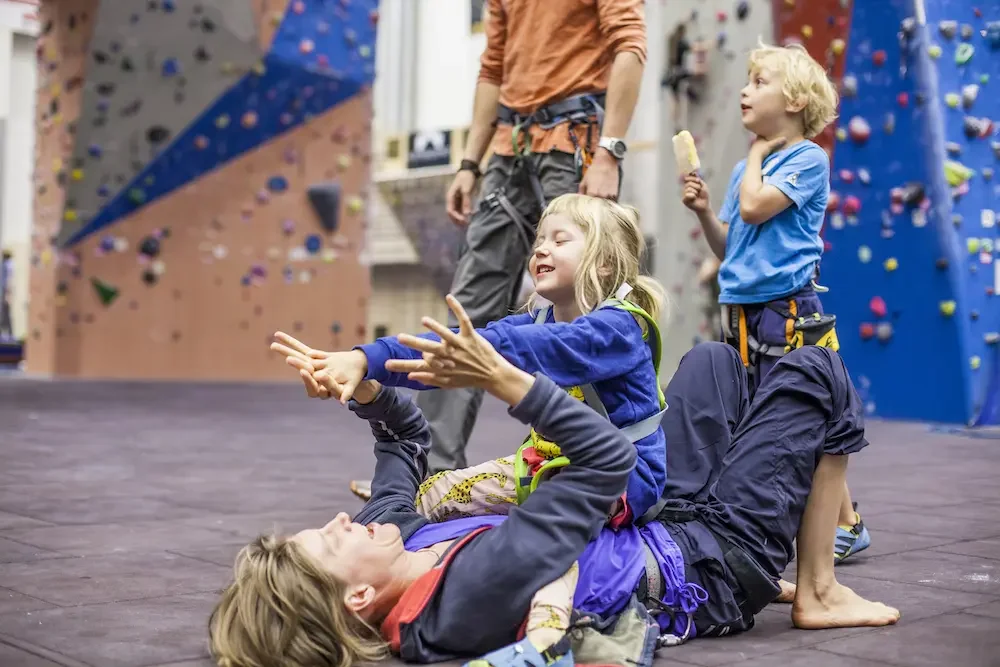
I couldn’t find a picture of the shoes by the door, but here’s a cute little Swedish family enjoying their climb at Klättercentret Telefonplan (www.klattercentret.se).
Contami(Nation)
On my train ride into Center City last week, I saw an abandoned newspaper sitting on a seat. Stop after stop, nobody touched it. And I found myself wondering: at what point did everything in the public realm become dirty or contaminated? Was it only after COVID, or did this shift begin long before? When did a forgotten newspaper become a health hazard instead of an unexpected find? A gift? A little win? (Or am I romanticizing a past that only existed in old movies?)
How deeply embedded are the impacts of COVID? Will everything remain “contaminated” in perpetuity? And how could softening our hyper-cautious boundaries and behaviors that – at least in my mind, we adopted (or maybe enforced) during the pandemic – actually improve our connection with one another and our wellbeing?
I’m curious about your thoughts:
How do you feel navigating public space today? Do you feel more on guard post-pandemic?
What’s one small social norm you wish existed where you live — or one you really miss from somewhere else?